

How to Scale Your E-Commerce Business With Strategic Freight Management
E-commerce businesses face a range of unique logistical challenges, including inventory management, regulatory compliance, supply chain disruptions and evolving customer expectations. For instance, about 51% of consumers factor delivery times into their purchasing decisions. As shipping windows narrow, businesses must adapt to keep up with transport speeds. Freight management is ever-changing, and growing companies need a long-term, scalable strategy.
Successful freight management can make all the difference in a company’s customer retention and return on investment. You can manage the entire transportation process safely and efficiently by using freight solutions.
This guide will explore the role of strategic freight management in scalable planning. Read on to learn more about implementing freight strategies for sustainable growth.
Why Your Current Shipping Strategy Falls Short
Tactical shipping focuses on the immediate tasks of getting the day’s orders out the door and meeting short‑term delivery goals. The problem is that this approach is primarily reactive, solving issues as they arise rather than preventing them. As a result, it often fails to support long‑range growth.
Tactical methods can lead to short-term success, but they rarely scale. Manual workflows and quick fixes eventually break down when order volume increases or processes become more complex. That’s why you must plan for a point when demand exceeds what your current systems can handle.
The Difference Between Tactical Shipping and Strategic Freight Management
Where tactical shipping focuses on immediate needs, strategic freight planning supports long‑term growth. Tactical decisions can be valuable in the moment, but they focus on short‑term execution — reacting to incoming orders, chasing spot rates and meeting daily or weekly goals.
Strategic freight management takes a broader view. It relies on contract rates, predictive planning and multiyear objectives, treating freight as an interconnected network rather than a series of isolated tasks. This shift also strengthens partnerships, moving from transactional interactions to more collaborative, long‑term relationships.
When a company’s growth outstrips its operational capacity, tactical methods alone can’t keep up. Instead of merely sending shipments out the door, strategic planning streamlines delivery, controls freight costs and supports sustainable scaling.
Signs You’ve Outgrown Your Manual Processes
Here are several signs your company has surpassed conventional freight methods:
- Slow turnaround times
- Inability to track inventory
- Operations team burnout
- Rising transaction costs
- Missed delivery promises
- High volume of customer complaints
Manual processes can become inefficient over time, leading to supply chain disruptions and financial loss. When routine tasks take longer than they should, it may be time to adopt more scalable strategies.
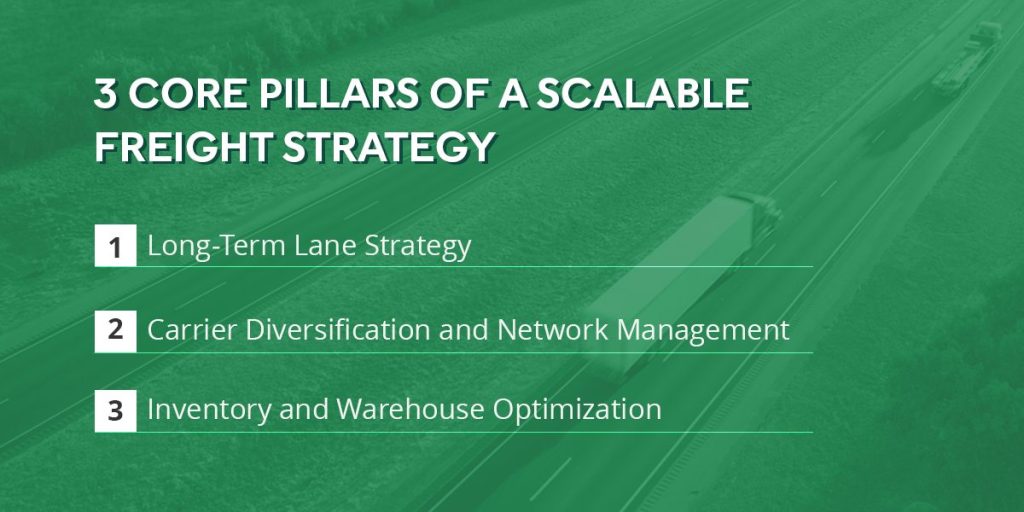
3 Core Pillars of a Scalable Freight Strategy
With strategic freight management, businesses can adapt capacity to demand without incurring unnecessary costs. Here are three primary characteristics of a flexible e-commerce freight strategy.
1. Long-Term Lane Strategy
Comparing shipping costs across different carriers can be beneficial in the short term by helping you secure the best rate at a given moment. However, checking the market for low spot prices can be unpredictable and time-consuming.
Those looking to scale their business can benefit from a long-term lane strategy that involves negotiating contract rates. This approach helps maintain steady prices in challenging market conditions. Stable carrier relationships often provide the best value over time.
2. Carrier Diversification and Network Management
Carrier diversification involves spreading shipping volume across several carriers. Effective network management offers the following advantages:
- Minimizing dependency on a single carrier
- Preventing bottlenecks in peak seasons
- Redistributing volume to avoid surcharges
- Protecting against sudden supply disruptions
- Improving delivery times with carrier flexibility
- Optimizing operations, costs and service quality
3. Inventory and Warehouse Optimization
Here are a few ways your company can optimize warehouse processes to reduce freight costs in e-commerce.
- Volume forecasting: Predicting future demand with market trends and data.
- Inventory tracking: Monitoring stock levels to boost order fulfillment speed.
- Storage optimization: Maximizing warehouse space and organizing goods for accessibility.
- Regional fulfillment: Distributing inventory in hubs located near where your customers live.
- Multi-warehouse models: Coordinating inventory across several locations.
Your e‑commerce brand may need to expand to an additional warehouse if your current facility has reached maximum capacity or routinely slows delivery times. Expanding into multiple locations means rethinking how you store inventory and move it across your network. That includes coordinating inbound freight to prevent stock outs and closely tracking outbound freight to reduce shipping delays. With careful planning, a multi‑warehouse setup can improve speed, resilience and the customer experience.
Using Data and Technology to Scale Efficiently
Technology is an essential tool for e-commerce companies looking to expand while minimizing freight costs. A case study in the Journal of Digital Economy reported up to an 80% reduction in stockout rates with machine learning inventory management systems.
Businesses that adopt transportation management systems and other automated technologies can analyze data more efficiently and fix errors before they reach customers. Here are a few applications to consider.
- Analytics: Collect and interpret freight data, including details about shipment, cost, inventory, delivery and customer feedback.
- Live visibility tools: Track the real-time location of shipments to coordinate logistics, predict delays and enhance reliability.
- Exception management: Identify and resolve shipping failures to improve supply chain efficiency.
Risk Management as You Scale
How do fast-growing e-commerce brands manage freight? As your company grows, so does the cost of failure. Your company can reduce transportation costs and transform your operations with a proactive approach.
Handling Capacity Constraints in Peak Seasons
Capacity constraints arise when labor, equipment, space and productivity are low. Preparing for demand influxes will prevent bottlenecks, delivery delays and stock shortages. How do e-commerce brands plan freight capacity for peak season? Consider these strategies as you prepare for busy periods:
- Analyze past data to understand capacity needs
- Prioritize high-demand items and shipping efficiency
- Run ads and promotions to keep up with competing brands
- Outline staffing, inventory levels and shipping for peak events
Claims, Compliance and Insurance
Implementing robust safeguards can prevent disruptions that result in financial or reputational damage.
- Data privacy
- Liability insurance
- Detailed documentation
- Proactive safety compliance
What Successful Brands Do Differently
Companies are beginning to prioritize supply logistics. According to a study by the National Association of Manufacturers, 86.2% of manufacturers have worked to de-risk their supply chain in recent years. In an increasingly complex network, e-commerce companies must scale their supply chains to balance cost, efficiency and customer satisfaction.
Strategic Implementation Before vs. After
Hidden fees and outdated strategies often cause e-commerce brands to overspend on freight. Mistakes include relying on a single carrier and neglecting real-time tracking and data analytics. Lacking a long-term solution leaves companies unprepared, leading to stockouts and delivery delays.
Leading e-commerce companies scale by using intelligent freight strategies. For example, Amazon stores high-demand items in warehouses near urban centers for quick deliveries, and Nike distributes inventory across channels and prepares goods ahead of launches to prevent stockouts.
KPIs That Matter for Scaling
Key performance indicators measure shipping performance, profitability and customer retention. Here are some KPIs to use for scaling e-commerce shipping.
- Cost per order: Divides total costs by the number of orders. The lower the CPO, the higher the profit margin.
- On-time in-full: The number of on-time, in-full deliveries divided by total deliveries, multiplied by 100.
- Damage rate: The number of damaged products divided by the total number of products handled, multiplied by 100.
- Accessorial percentage: The cost of accessorial fees divided by the total transport costs, multiplied by 100.
Partner With Phoenix Logistics for Strategic Growth
As a top logistics provider for small and medium-sized businesses, Phoenix Logistics is a trusted partner for streamlined freight solutions. With years of expertise, our dedicated team delivers custom services for businesses, including transportation management, return and recall logistics, freight brokerage services, warehousing solutions and supply chain visibility.
We provide expert guidance through complex supply networks so you can have peace of mind that your products will reach their destination safely and on time. We offer full and less-than-truckload, heavy haul, overdimensional and international shipping, in addition to van, flatbed and refrigerated freight solutions.
We’re here to make your freight process more transparent and efficient. With our strategic framework, your business will have access to industry expertise, cost savings, risk management and adaptable strategies tailored to your evolving needs.
Ready to build your scalable freight plan? Use our live rate tool or contact our team to get an instant quote!