


LTL Freight for Growing Manufacturers: Scaling Your Supply Chain
As your business scales, your shipping needs evolve. Moving to less-than-truckload (LTL) freight is a natural step for growing manufacturers who ship heavier loads and palletized goods.
This guide provides a framework to optimize LTL shipping and turn it into a competitive advantage that supports your continued growth.
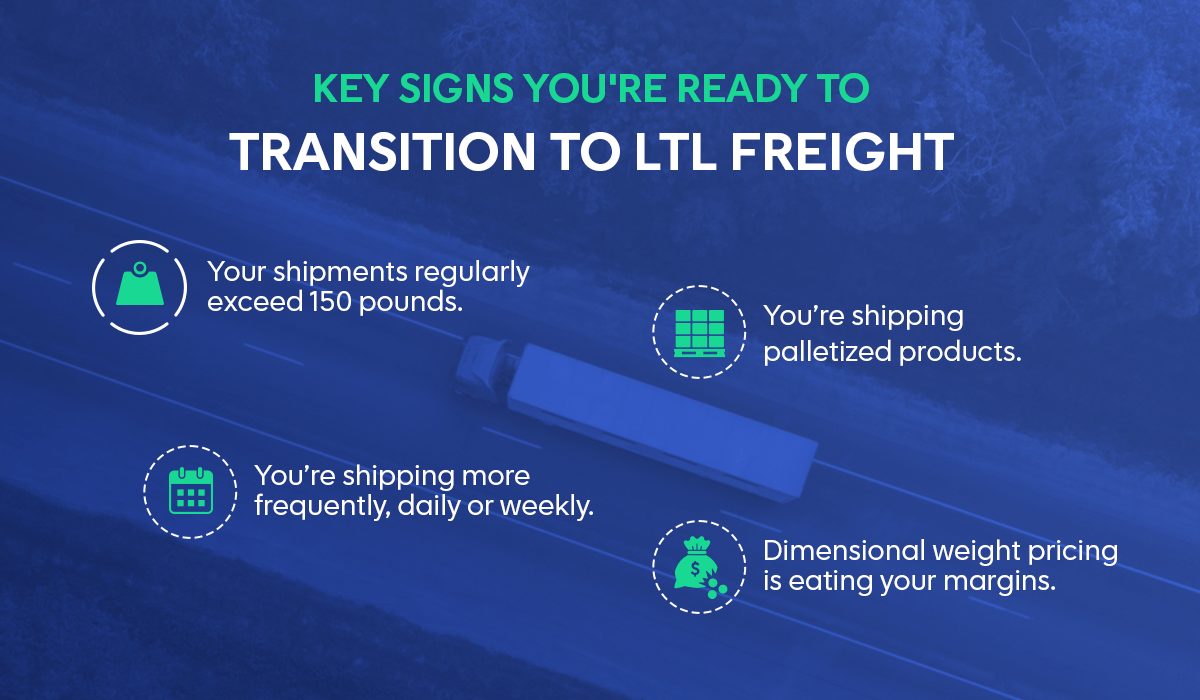
Key Signs You’re Ready to Transition to LTL Freight
LTL freight is a strategy that works for small and medium businesses (SMBs) that need flexible, scalable logistics solutions. Here are signs you’re ready for the transition:
- Your shipments regularly exceed 150 pounds.
- You’re shipping palletized products.
- You’re shipping more frequently, daily or weekly.
- Dimensional weight pricing is eating your margins.
The LTL market is projected to reach $342.09 billion by 2030, highlighting its role in the economy and in supporting manufacturers’ growth.
LTL Shipping’s Benefits for Scaling Manufacturing Operations
These key benefits are why LTL freight is the strategic choice for growing manufacturers.
Lower Costs Through Shared Capacity
LTL provides cost savings through a shared-space model. Your freight shares trailer space with shipments from other companies heading in the same direction. This means you only pay for the space you use rather than booking a full truckload.
Flexibility to Scale With Production Demands
You can ship raw materials and finished goods on the same service level without committing to a full truckload. When production ramps up, you scale your shipping volume up. When things slow down, you scale back. You pay for what you ship when you ship it. This adaptability makes LTL an essential freight strategy for manufacturers who need logistics that grow with them.
Reliability for Managing the Full Manufacturing Supply Chain
Your ability to receive raw materials and deliver finished products efficiently determines your production capacity, customer satisfaction and, ultimately, your profitability. LTL shipping gives you the reliability to manage both sides of this equation.
LTL carriers specialize in scheduled, predictable deliveries that help you plan production around material availability. You can coordinate shipments from multiple suppliers arriving on specific days and maintain lower inventory levels without risking stockouts.
LTL shipping provides professional handling for palletized finished goods with built-in tracking and delivery confirmation. You get predictable transit times that let you commit to delivery windows. Research shows that buyers prioritize on-time delivery and prefer to wait longer for a guaranteed delivery date than risk a late shipment.
LTL Freight Strategies for Small to Midsize Manufacturers
These strategies help you optimize manufacturing logistics.
Maximize Your Shipment Density
Freight class is a standardized classification system managed by the National Motor Freight Traffic Association (NMFTA) based on the density, stowability, handling and liability of a shipment. Freight classes range from 50 to 500. The lower the class, the lower the shipping rate.
Density measures weight per cubic foot and is the most significant factor in determining freight class and cost. Denser shipments ship at lower rates. To reduce manufacturing freight costs, keep these tips in mind:
- Optimize packaging sizes to fit your product snugly: Every cubic foot of empty space you ship costs money. Choose boxes or crates that minimize void space while still adequately protecting your products.
- Stack items efficiently to create compact loads: Place heavier items on the bottom and lighter items on top to build stable pallets that use vertical space effectively.
- Eliminate unnecessary packaging materials: Extra layers of cardboard or excessive cushioning add volume without adding product value. Find the balance between protection and efficiency.
Palletize Your Freight Correctly
Proper palletization protects your products during transit and prevents carriers from reclassifying your shipment at a higher rate. Follow these best practices:
- Avoid overhang beyond the pallet edges: Freight that extends past the pallet edges creates handling difficulties and increases the risk of damage. Keep all items within the pallet footprint.
- Distribute weight evenly across the pallet surface: Unbalanced loads shift during transit and can tip or collapse. Center heavier items and ensure the load sits level.
- Use proper wrapping techniques to prevent shifting: Stretch wrap should secure the load to the pallet with multiple passes around the base and sides. Corner protectors add stability for tall loads.
Balance Inventory and Freight Costs
Balancing inventory levels with freight costs requires understanding two fundamental approaches.
Just-in-time manufacturing shipping delivers materials exactly when needed, minimizing warehouse space and inventory carrying costs. You order smaller quantities more frequently, keeping capital free and reducing the risk of obsolete inventory.
Economic order quantity takes the opposite approach by ordering larger quantities less frequently to reduce per-unit purchasing and shipping costs. You pay less per item and per pound shipped, but you need warehouse space and tie up capital in inventory.
LTL shipping’s flexibility supports both models. You can ship partial pallets multiple times per week to support just-in-time production or consolidate larger shipments to optimize freight costs under an economic order quantity model.
The right balance depends on your warehouse capacity, production schedule and cash flow priorities. A logistics partner can help you analyze these factors and adjust your strategy as your business scales.
Partner With a Logistics Expert to Streamline Shipping
Working with a logistics provider or broker is the key to implementing these strategies. The best freight solutions for small manufacturers come from partners who understand how to choose freight carriers for manufacturing and can navigate the complexity on your behalf.
Here’s what the right partner provides:
- Carrier network access: A logistics expert builds relationships with freight carriers across regional, super-regional and national networks. This gives business owners and supply chain managers access to competitive rates and reliable service that would be difficult to negotiate independently.
- Technology solutions: Your partner’s Transportation Management System (TMS) delivers real-time rate comparisons, shipment tracking and delivery confirmation to help you manage production schedules and customer expectations more effectively.
- Seasonal capacity planning: A logistics expert anticipates peak periods and secures capacity in advance, ensuring you can ship when demand spikes without paying premium rates or experiencing delays.
- Operational expertise: Your partner handles the operational details of shipping raw materials and finished goods efficiently. They advise on freight class determination, recommend packaging improvements and resolve issues quickly, so you can focus on manufacturing.
Partner With Phoenix Logistics and Get Your Live LTL Shipping Quote
You’ve learned how the right logistics partner makes these strategies work. Phoenix Logistics specializes in helping growing manufacturers optimize their LTL shipping. Our team understands the unique challenges you face as you scale.
What sets us apart is our ability to provide real-time shipping quotes. Use our LTL Instant Rate Tool to get yours today to compare rates instantly and make informed decisions without waiting for callbacks.