

What Is Freight Class and Why Does It Matter?
Misclassifying freight is an expensive mistake when shipping LTL. A single incorrect freight class calculation can trigger reclassification fees and shipper billing disputes. These errors create operational headaches and strain relationships with shippers.
But what is freight class in simple, actionable terms that relate to your business? Freight class calculation follows a clear, repeatable process. Understanding the factors that determine class and applying them helps to reduce costs by enabling predictable shipping without unexpected charges, so you can ship with confidence.
Why Does Freight Class Matter?
Freight class is a standardized shipping category assigned to LTL shipments based on the National Motor Freight Classification (NMFC) system. The system is maintained by the National Motor Freight Traffic Association and uses 18 distinct classes.
The class assigned to your shipment directly determines your shipping rate. In other words, freight class is critical for budget control and operational efficiency, especially for small manufacturers. It’s the single biggest factor in determining LTL shipping costs.
What Factors Determine Freight Class?
Four factors determine where your shipment falls on the classification scale:
- Density: Freight density is the space an item occupies relative to its weight. Higher density typically means a lower class and lower cost.
- Stowability: This relates to how easily the item can be stored with other freight. Items that are hazardous or cannot be stacked will have a higher class.
- Handling: This refers to the ease or difficulty of loading and unloading the freight. Fragile items or special equipment increase the class.
- Liability: This accounts for the risk that the shipment will be damaged or stolen. Higher value or fragile items lead to a higher class.
Understanding how LTL shipping works helps you anticipate which factors will apply to your freight.
A Step-by-Step Guide for How to Calculate Freight Class
Knowing how to determine freight class and calculating the exact freight density is essential for manufacturing supply chain management. It becomes routine once you understand the steps, and it helps you better understand how freight class affects shipping costs.
Manufacturers seeking effective shipping solutions for small businesses can use this process to take control of their shipping costs.
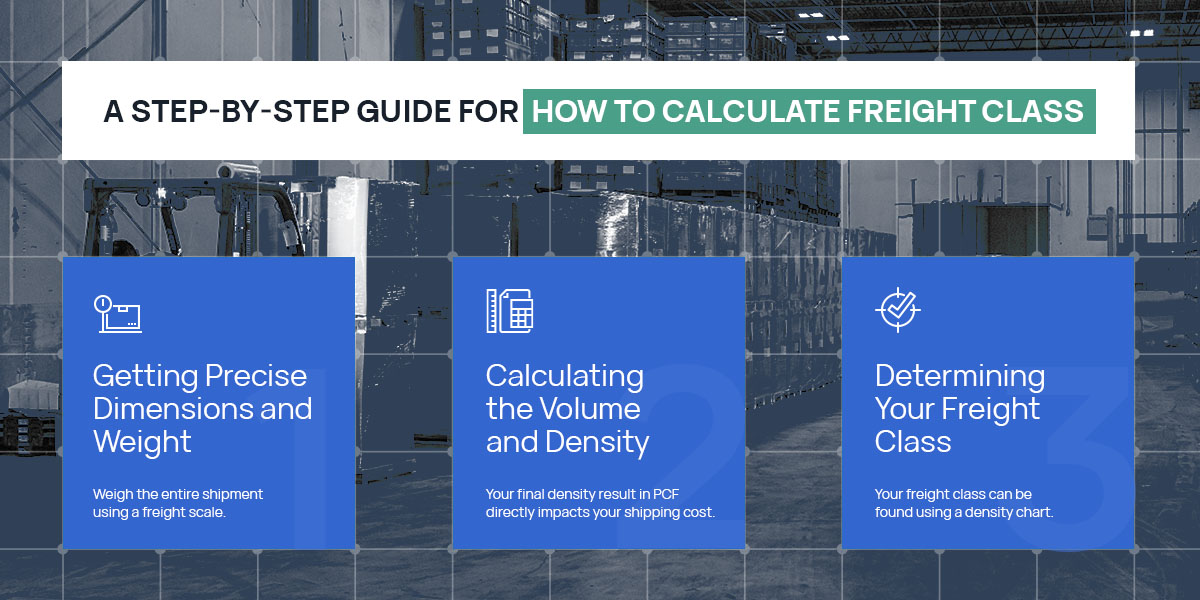
1. Getting Precise Dimensions and Weight
This step determines how accurate your final results will be. Measure the fully packaged and palletized shipment at its longest, widest and tallest points in inches. Avoid estimating or eyeballing it. Use a tape measure or dimensional scanner for precision.
Weigh the entire shipment using a freight scale. Include the pallet and all packaging materials in the final weight. Excluding these materials will result in an inaccurate density calculation and may lead to reclassification.
2. Calculating the Volume and Density
Calculating volume and density accurately is key to optimizing logistics and controlling costs. Use these two formulas to determine your shipment’s density:
- Volume formula: (Length x Width x Height) / 1,728 = Total Cubic Feet
- Density formula: Total Weight / Total Cubic Feet = Pounds per Cubic Foot (PCF)
The number 1,728 is used to convert cubic inches to cubic feet (12 x 12 x 12). Your final density result in pounds per cubic foot directly impacts your shipping cost. Higher-density shipments occupy less trailer space relative to their weight, so shippers reward them with lower freight classes and lower rates.
3. Determining Your Freight Class
Your freight class can be found using a density chart. This tool matches your calculated density to the corresponding freight class. Take your final pounds per cubic foot calculation from Step 2. You can then match it to the corresponding class.
Understanding the 18 Freight Classes
Your freight class helps you make informed shipping decisions. The following list is a general guideline for understanding where your shipment falls on the freight class scale:
- Class 50 (50+ PCF): Steel, cement, machinery, engines, cast iron products
- Class 55 (35-50 PCF): Bricks, hardwood flooring, construction materials, mortar
- Class 60 (30-35 PCF): Car parts, appliances, bottled beverages, canned goods
- Class 65 (22.5-30 PCF): Automobile engines, small appliances, tools, boxed books
- Class 70 (15-22.5 PCF): Food products, automobile accessories, books
- Class 77.5 (13.5-15 PCF): Tires, bathroom fixtures
- Class 85 (12-13.5 PCF): Crated machinery, manufactured food, cloth, cardboard boxes
- Class 92.5 (10.5-12 PCF): Computers, monitors, refrigerators
- Class 100 (9-10.5 PCF): Car covers, canvas, boat covers, wine cases
- Class 110 (8-9 PCF): Cabinets, framed artwork, table saws
- Class 125 (7-8 PCF): Small household appliances, printers
- Class 150 (6-7 PCF): Auto sheet metal parts, bookcases, furniture
- Class 175 (5-6 PCF): Clothing, couches, stuffed furniture
- Class 200 (4-5 PCF): Aircraft parts, aluminum tables, packaged mattresses, sheet metal parts
- Class 250 (3-4 PCF): Bamboo furniture, mattresses, box springs, plasma televisions
- Class 300 (2-3 PCF): Wood cabinets, assembled chairs, tables
- Class 400 (1-2 PCF): Deer antlers, ping pong balls
- Class 500 (Less than 1 PCF): Gold dust, ping pong balls, balloons, bags
Lower class numbers mean lower shipping costs, while higher class numbers result in higher rates.
What Are NMFC Codes?
National Motor Freight Classification (NMFC) codes are specific numbers. They are assigned to particular commodities by the NMFC system. Density is usually the primary classification factor, but some items may have a predetermined class based on their NMFC code. This is common for items with unique handling, stowability or liability characteristics.
For example, apparel might carry NMFC code 49880, while electronics could be classified under 116030. Knowing how to look up NMFC codes ensures you get the correct classification.
If your shipment has an assigned NMFC code, that code may dictate your freight class. Check with your shipper or use the NMFC database to confirm whether your product has a specific code that overrides density-based classification.
How to Avoid Freight Class Mistakes That Increase Costs
Even experienced shippers make classification errors. But having insights into how to avoid common freight class mistakes can make a huge difference. Here are the three most common mistakes small manufacturers make, along with real-world examples.
Inaccurate Measurements
The most common error is estimating or eyeballing dimensions rather than measuring precisely. A furniture manufacturer might estimate a pallet as 48 x 40 x 60 inches when it actually measures 48 x 40 x 68 inches. That eight-inch height difference changes the cubic footage calculation. This difference can decrease your shipment’s density and push it into a higher class.
Forgetting to Account for Pallets or Packaging
A common mistake is weighing only the product and ignoring the pallet’s 40 to 50 pounds. This artificially inflates your density calculation and may initially result in a lower class than you should have. When the shipper reweighs and remeasures at their terminal, they’ll reclassify the shipment and bill you the difference, plus a reclassification fee.
Using the Wrong NMFC Code
Using vague commodity descriptions on the Bill of Lading can lead a shipper to assign a higher default class. Listing “machinery parts” without specifying the NMFC code or accurate density gives the carrier discretion to classify conservatively, often at a higher rate.
Always provide specific commodity descriptions and NMFC codes when applicable to avoid this costly error.

Get an Accurate Freight Quote With Phoenix Logistics
Calculating freight class accurately is essential, but you don’t have to manage the entire shipping process on your own. Phoenix Logistics provides transparent, reliable freight solutions for manufacturers who need visibility and control. Use our online tool to get live LTL rates instantly, or submit your details for a custom FTL quote tailored to your specific needs.
We offer a more personal approach with dedicated support and proactive communication. Whether you’re shipping routine orders or managing production-critical freight, we’re here to help you execute with confidence.
Are you looking to scale operations through freight accuracy? Get a live rate or call us at 317-926-8000 to discuss your freight strategy.